Tuesday, September 28, 2010

research

I was looking at www.contemporaryartdaily.com. It had a really diverse assortment of pieces. My goal was to pick a few that I liked and try to try to figure out why they were appealing to my when many of the others weren't, and then think about what they were accomplishing in perspective to my own work. I think that will generally be my goal. What I'm kind of hoping to do with this research is broaden my interests and open some doors in terms of what I associate with how I make work.

1) Lisa Oppenheim (at Klosterfelde)


http://www.contemporaryartdaily.com/2010/09/lisa-oppenheim-at-klosterfelde/#more-17147

The exhibition is called "Blood to Ghosts." The images are pretty over-whelming, but in a strangely simple way. There's something so graceful about them. They're photograms that show a seamless overlapping or progression of the moon's phases from 1851 to the repetition of identical phases in 2010. So, in a way, the images are recycled but simultaneously fresh: the old and the new are adjusted to create the final result, which is an original work.
I love the simplicity of these images. They're so large and powerful but somehow manage to sustain a fragile sensibility. I think a lot of that is caused by the way the perfectly round moon contrasts with the foggy, faded ambiance around it. The moon is so easily recognizable, but when I look at Oppenheim's images it's as though I'm really seeing it for the first time. I have strong emotional reaction to them: a lonely, romantic reminiscence almost.
It's strange for me to be so drawn to such a such a simple image. I'm the type of person to be more interested in pieces with lots of materials, layers, physical depth to the medium. Maybe personal experience with the frustration of making work this way is what makes the idea of such a simple-looking, clean image so appealing. And of course there are the layers of the new photographs atop the old, so there is depth, even if it is not directly visible (I suppose it's more of an imagined depth).

2) Group Show (at UNTITLED)
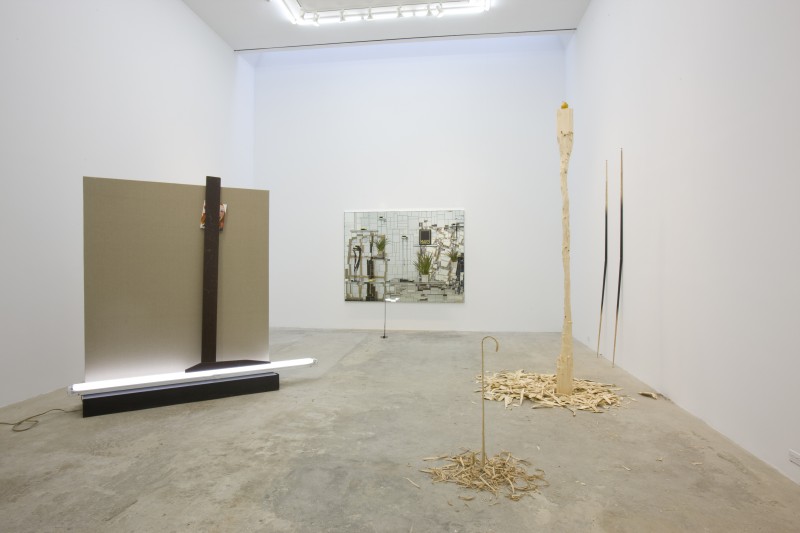

This show contained a multitude of small, three-dimensional installations by David Adams. Again, I am puzzled by the fact that I was once again drawn to very visually simple pieces. Most of the sculptures seemed to be manipulations of found objects, which is a very satisfying idea to me.
Although virtually no information was provided to the viewer in the description of the show as to the intent of each piece, what I take from the set is that these pieces have very specific intentions to the creator, intentions that don't necessarily translate to the viewer. Still, somehow, I'm kind of ok with that. I like the ambiguity of it while still taking from it that sense of specificity to the artist.
The structures, like I said, are simple, but a sense of the complexity of the artists mindset is still present. There's like a bizarre narrative that to the sculptures, like finding a book written in another language: you know there is a story but that doesn't help you read it.
I have a feeling that the structures would have a much larger impact in person, however.

This was a piece I liked in particular. It looks to m like a cane that was gradually widdled away into this thin, fragile form.

My Analysis:
What does it mean that I have (as of late anyway) noticed that I tend to be more drawn toward simple, minimalist art?...I'm not entirely sure.
Part of me feels like my art is getting too congested within itself. I still am very much in favor of layers and texture, but maybe there's away to integrate a material or textural complexity with some kind of the simplicity I'm seeing in these two artists' work. Maybe compositional simplicity?
I think this artist (Maria Chevska) does an effective job of joining compositional simplicity and defined texture in this painting:

You definitely get a sense of depth and I really enjoy the way the layers underneath are peaking through. It looks worked on, yet the simplicity of it makes it seem completely effortless. I like the way those two forces contradict each other. That's definitely something I would be interested in exploring in my work.


Wednesday, November 19, 2008

Thursday, October 30, 2008

gender-swap stuff


response to: "the ecstasy of influence"


Both of the images above are appropriated images. They are pieces created by Andy Warhol. I chose them because he in particular got into some serious legal trouble because of copyrights. There were many lawsuits filed against him because of the images that he improvised for his art.

After reading "the ecstasy of influence" I formed my own opinions on appropriation of images, and, to a certain extent, they are somewhat conflicting.

On the one hand, part of me is 100% in favor of creativity. So, for example, if I uploaded a photograph that I took of a piece of art or even of something unrelated to art, and another artist ended up using it in a piece, my first reaction would be to be very flattered, especially if that artist was already accomplished in their profession. The idea of that artist(whether well-known or obscure) having inspired by my art so much that the want to include it in a piece of their own is very appealing to me, as I'm sure it is to many. I think there is something to be said for the ability to share work. A good example of this is "JONES SODA." This company has consumers of their products take photographs and send them into the company. If they approve of the photographs, they put pictures of them on their bottles. Thus, they are managing to differentiate from other companies, and the artist gets the satisfaction of knowing that their photograph was chosen and is now being displayed on a product where millions will be able to see it.

On the other hand, there is something unsettling about putting time and effort into a work, and then seeing someone else incorporate it into their piece without recognition. It feels very sneaky to me. I personally think, that as long as credit is given to the person whose work is being borrowed, the act of borrowing itself is alright. For example, the website "corbis.com" is a site where one can buy pictures taken by professionals to be used in adds and projects. The photographs have the corbis logo on them so that none can be stolen or hot-linked. Another example is livejournal.com. I have a livejournal account and people tend to upload icons often. They are free for the taking, as long as you give credit to the user you took them from. If credit is not given, and the maker of a particular icon sees this, they get very upset. Even though it is something small, it still holds value, and it is still hurtful to know that your work is being taken advantage of.

This brings up another aspect of appropriation: is alright to take some else's image and use it in your own work, if your work isn't displayed to the public? For example: using someones photograph in a collage for a school assignment. In my opinion, I belive it is. No harm is being done, and as long as the image doesn't leak somehow, I think it is innocent enough.

The article also brings up an interesting point:

"If nostalgic cartoonists had never borrowed from Fritz the Cat, there would be no Ren & Stimpy Show; without the Rankin/Bass and Charlie Brown Christmas specials, there would be no South Park; and without The Flintstones—more or less The Honeymooners in cartoon loincloths—The Simpsons would cease to exist. If those don't strike you as essential losses, then consider the remarkable series of “plagiarisms” that links Ovid's “Pyramus and Thisbe” with Shakespeare's Romeo and Juliet and Leonard Bernstein's West Side Story, or Shakespeare's description of Cleopatra, copied nearly verbatim from Plutarch's life of Mark Antony and also later nicked by T. S. Eliot for The Waste Land. If these are examples of plagiarism, then we want more plagiarism."

This paragraph stuck me as very honest, and after I read it , I thought about the validity that it held. People tend to give tremendous leeway to plagerism if it is funny and entertaining, or if the act is done by a large, well-known company( FOX, for example).

It is interesting to think about appropriation in terms of morals, and "the ecstasy of influence", by Jonathan Lenthem definitely provides food for thought on the topic.